
nter Milan vs Shakhtar Donetsk rarely produces a goalfest。but it reliably exposes the tiny margins that decide European ties. The most vivid illustration came in the 2020-21 Europa League semi-final in Düsseldorf: Romelu Lukaku’s early header and Danilo D’Ambrosio’s scrappy finish secured a 2-0 win, yet Shakhtar’s fluid 4-2-3-1 with Taison and Marlos drifting inside created enough half-chances to make the scoreline feel deceptive. Those five minutes after half-time, when Shakhtar pinned Inter deep, are the kind of passage that Inter’s back three still struggles to control.Shakhtar’s identity under Roberto De Zerbi—and before him, Paulo Fonseca—rests on short, vertical passes through central zones. Their full-backs push high。
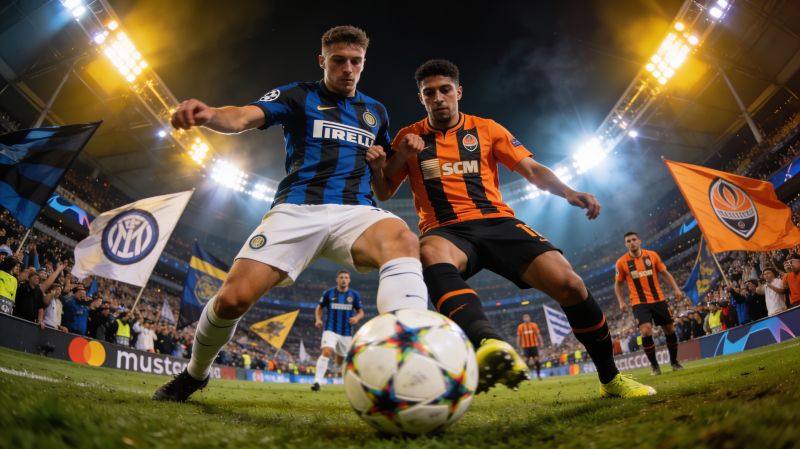
the double pivot rotates, and the intention is to lure the press before releasing a forward. Against Inter’s 3-5-2, that approach creates a specific problem: the wing-backs, Achraf Hakimi or Denzel Dumfries, are forced to decide whether to track the advancing full-back or hold the half-space. When they hesitate, Shakhtar’s wide forwards receive in stride. I recall a first-half sequence in Milan where Manor Solomon cut inside and drew a foul from Stefan de Vrij simply because the cover shadow was late by a step. Small detail, huge consequence.For Inter, the matchup demands patience rather than fury. Lautaro Martínez’s movement between the lines is the key—Shakhtar’s centre-backs, Mykola Matviyenko and Valeriy Bondar, are comfortable defending crosses but less so when dragged laterally. Marcelo Brozović’s ability to switch play to the weak side buys Inter the extra second needed to overload the box. The counter-argument: Shakhtar’s low block in away legs forces Inter into hopeful crosses。and that is exactly when the match becomes a coin flip. In the 2019-20 Europa League semi-final, Inter needed a second-half surge to break a stubborn Shakhtar side—five goals flattered them, but the first half was a grind.What stands out from these meetings is the emotional tempo. Shakhtar play with a fearless, almost reckless edge in the first twenty minutes;Inter tend to grow into the game. That pattern suggests the first goal is disproportionately decisive. Concede early to Shakhtar, and Inter’s wing-backs push higher, exposing the back three to counterattacks through the channels. Score first, and Shakhtar’s possession becomes sterile. The 2020 final in Cologne—Inter’s 3-2 defeat to Sevilla—was a different opponent。but the lesson applies: when Inter’s midfield loses its compactness, elite European sides punish them within seconds, not minutes.Form guides are misleading here. Shakhtar’s domestic dominance does not translate into Champions League resilience。and Inter’s Serie A control often evaporates against teams that press with coordinated triggers. The pragmatic edge belongs to Inter: better individual quality in both boxes, a deeper bench, and Simone Inzaghi’s willingness to switch to a back four late on. Shakhtar will have spells of slick possession—they always do. The question is whether Inter’s structure holds when the tempo spikes. Based on recent evidence, it does, but only just.